Building History
By John Lyons
The original building was the middle property of a row of three late medieval houses, the others being The Red Lion and The White Swan (demolished 1939). This row was an important feature in the medieval high street of Knowle. This was mainly due to their location facing onto the square opposite the church and it is likely that this building was the home of a person who had some standing in the community.
It appears, supported by architectural evidence, that this building was a medieval farmhouse which had an open hall living space and was typical of houses found in rural villages of the middle Ages. Today the building has been greatly modified, its external building fabric changed and its outbuildings demolished. Consequently it is difficult to see its medieval heritage from the street.
Under a stone slab in the office is a well. Maybe connected to the secret tunnel rumoured to run from the church, and up the High Street!
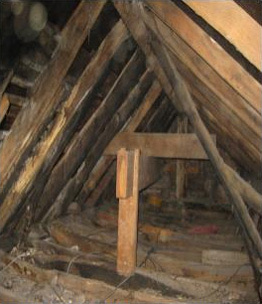
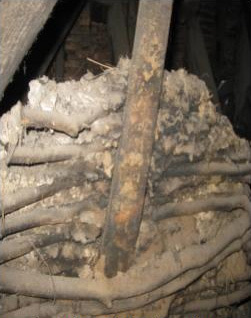
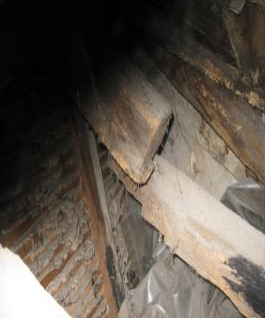
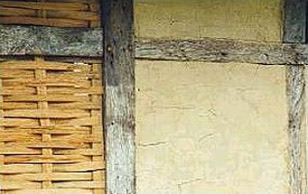
Fortunately within the building itself there are clues to its age and origins as shown in the photographs below.
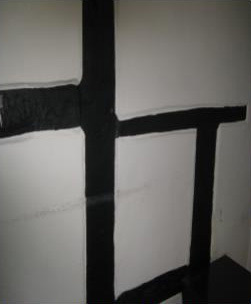
Timbered wall in office above Butchers shop
End wall of loft (adjoined the Swan before its demolition in 1936)
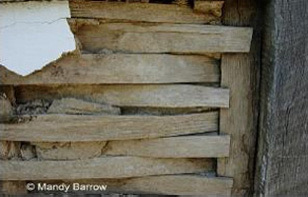
Wattle and Daub (twigs, dung, clay, sand, straw and horse hair) preserved in the loft
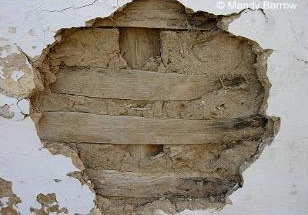
The Wattle and Daub still with the original beams
Wattle is the intertwined sticks that are placed in a wall between posts. You can see the woven sticks in the photographs below.
The wooden timbers were often coated with black tar to help protect them from rotting
Daub is a mixture of clay, sand and dung that is smeared (daubed) into and over the wattle to make the wall
The daub was often painted with limewash making it look white
This building started out as a classic rural medieval timber framed building and what the building was used for is difficult to establish with certainty, especially for the period covering the 15th and 16th centuries.
Records show the shop was owned by the Knowle Hall Estate and was described as a “House and outbuildings” (1816) and subsequently described in later records as “House, Butcher’s shop and yard” (1841).
The shop appears to have been used as butchers for approximately 200 years.
In the early 1800’s the Allday’s were trading as Butchers from these premises. According to the 1861 Census the occupants then changed to Corbett’s, employing three men and a boy.
It then appears from 1888 until 1901 the shop was run by Dick Barratt.
The 1901 Census then shows the premises occupied by the butchers, Joshua Harper (aged 30 years) and Frank Harper (aged 28 years), along with sister Fanny Harper (aged 32 years) who was acting as house keeper. There was also a servant/butcher Charles Chant.
In 1911 Joshua (the head of the family) seems to have disappeared, leaving Frank, Fanny, Alan Hope (a schoolboy / ward) and 3 servants (of which 2 were butchers assistants).
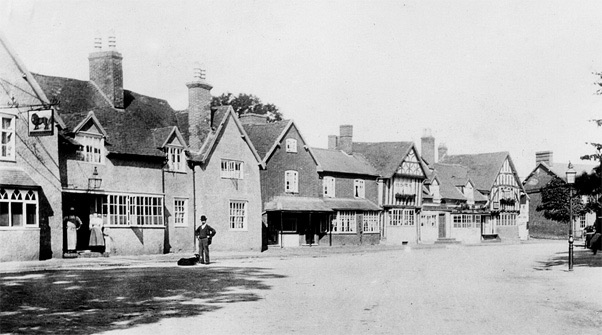
The shop, about 1900 (maybe Dick Barratt’s time), the Red Lion and the White Swan
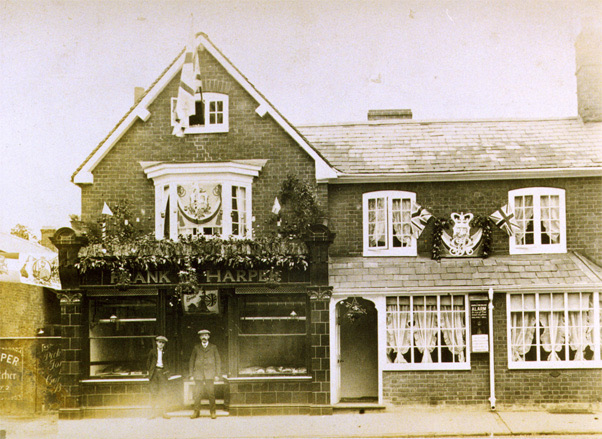
Frank Harper celebrates George V’s coronation 1911
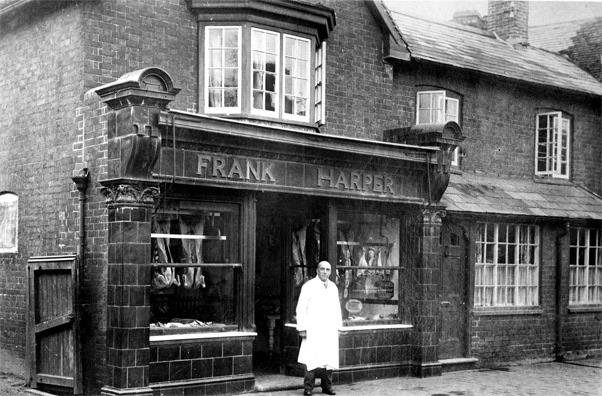
Frank Harper outside the shop in the 1940’s
Frank Harper appears to have been the sole proprietor from 1906 and he carried out many improvements to the shop over the 40 years or so that he traded from this location.
Frank then sold these premises to Phil Lyons, who was already trading as a butcher in The Victoria Buildings (corner of Lodge Road and Station Road).
Discover how the Lyons family built their butchery dynasty on this historic site.
The Lyons Family →